Jay Walker’s Library of Wonders - I read with awe at the amazing collection of historical artifacts amassed by Jay Walker, founder of Walker Digital. Equally fascinating is the 3,600 square-foot library, specially designed and constructed to be an “engagement space”. He called it “a room, a library, that would be about human imagination”. I could spend days reading/marvelling at, inter alia, the scholar’s rocks, celestial atlas (first non-Earth centric drawings), Nuremberg Chronicle (first illustrated history book), Enigma code machine.
Biblioburro - This inspiring story is about a different kind of library: a one-man operation aided by two donkeys. On weekends, the trio bring books to remote villages in Colombia. And Luis Soriano has been doing this for the past decade, driven by the belief that reading can make a positive difference to childrens’ lives.
30 Simple Ways to Get Your Child Ready to Read - Great list of easy tips.
October 25, 2008
October 18, 2008
October 15, 2008

Mac OS 10.5.4 on iMac 2 GHz Intel Core 2 Duo
I switched to Mac exactly 6 months ago.
It sure took a while to get used to the interface and different keyboard shortcuts for common tasks, eg. using the Cmd+key combination instead of the familiar Ctrl+C/V (copy/paste) and Alt+Tab/F4 (switch/quit application) key strokes.
But I knew the switch was complete when I reached for Alt+Q instead of Alt+F4 to quit an application on my Windows laptop.
Much has been written about the practical side of switching. These three guides gave me confidence to make the conversion after my PC crashed then:
1. How to Switch to the Mac | The Tao of Mac
2. Guide for Switching to a Mac | Lifehacker
3. Switch 101 | Apple Support
As I looked back, I realised that the deciding factor was not knowing how to switch.
I had been seduced by the form, the cool factor, the culture that Mac represents.
I wanted to try something new, have a different experience, and be a happier person. Yes, design can make you happy.

Image credit: Crouching Donkey
October 11, 2008

Discover Your Inner Economist (DYIE) is not a typical self-help book. After all, it was written by an economics professor. Tyler Cowen blogs at the popular Marginal Revolution.
In the book, Cowen offered practical how-to tips and advice, grounded in economic logic and insights about human nature. Take the reward/punishment idea, for example. It may backfire if it causes people to feel they are not in the driver’s seat. This innate need to be in control trumps the carrot-and-stick principle (which may explain my tendency to avoid working on tasks that come with treats or threats - procrastination is a way to exert control).
Cowen applied economic reasoning to everday activities - how to enjoy books/movies/paintings, get better treatment from your doctor, give to the needy, cultivate self-control, and so on. To profit from leisure reading, we should follow our interests and not feel guilty about not liking popular works. Skip passages, follow one character first, give up a book if its not worth finishing. To quote from Samuel Johnson, “A man ought to read just as inclination leads him; for what he reads as a task will do him little good.”
I was surprised to read about Singapore in DYIE. In the chapter on how to find cheap and good food, Cowen wrote:
October 4, 2008
September 21, 2008

Image credit: Luis Fabres
Here are two interesting quotes from a recent post at if:book. The first is on why books remain a viable media.
September 20, 2008


Before Dan Brown’s Da Vinci Code, there was The Eight. The figure eight refers to the infinity symbol, an arcane formula hidden in the scattered chess pieces of the Montglane Service, an ancient artifact owned by Charlemagne. The race to decipher the secret is played out as an epic chess game across time (1790s and 1970s) and space (three continents).
I am looking forward to read The Fire (to be released on 14 October 2008), Katherine Neville’s sequel to The Eight. The Game resumes thirty years after the events in the first book. This time, the origin of the mystical chess set will be revealed.
September 12, 2008
This 2-minute Nokia ad envisioned a compelling future created by mobile devices. But not everything has changed. I still prefer to read online and browse the web on a computer screen. Maybe the next generation of smartphones running on Android OS may deliver the promise of ubiquitous internet.
Anyway, I was sufficiently inspired to type out the ad transcript:
In the beginning, was a screen. Millions of us came together in a public place to understand the present, to see visions of the future, sharing emotions, sharing experiences that shaped our lives.
Then there was a second screen. It connected us to our world, and even to other worlds. It gave us amazing new games to play, it made us think, and got us talking. But although this is a world we could all share, the experience itself was becoming private.
Then came a third screen. It changed the way we work and play. It became part of something much bigger, the internet, and a revolution happened. We could play new games in new ways, find new music in new places. New communities, new kinds of communities emerged but the experience had become individual, even solitary. The sense of community felt real but it was virtual.
And then, everything changed. And it changed forever. Everything came into this device that fit into our pocket. We went back out into the world. We listened to what we loved when we liked; we played when we wanted where we chose; we shared what inspired us with everyone we cared about; we carried our sense of purpose with us; we discovered new people, places and experiences. And our sense of purpose kept growing. It was the end of something, it was the beginning of everything.
Welcome to The Fourth Screen.
September 11, 2008
August 23, 2008
The late Carnegie Mellon Professor, Randy Pausch (1960-2008), gave the talk, Really Achieving Your Childhood Dreams, aka Last Lecture, on 18 September 2007, about a year after he was diagnosed with pancreatic cancer.
One of the life lessons he shared was indirect learning (what he called “head fake”) as a powerful teaching tool (eg. using storytelling to teach programming). The talk has two head fakes: 1) it is not about achieving dreams but how to lead your life, 2) it is not for the audience/viewers, but for his 3 kids. In April 2008, the book version of The Last Lecture was published.
On 25 July 2008, Randy Pausch passed away, leaving behind an enduring legacy.
If you want to watch the 75-minute talk (highly recommended), you may wish to block some quiet time for the experience.
Ideas I hope to imbibe from the lecture:
1. Be good at something by working hard.
2. Most of what we learn, we learn indirectly (“head fake”).
3. Experience is what you get when you didn’t get what you wanted.
4. Find the best in everybody; no matter how long you have to wait for them to show it.
5. Brick walls are there for a reason: they let us prove how badly we want things. Brick walls let us show our dedication.
August 16, 2008
August 15, 2008
August 10, 2008
August 6, 2008
August 3, 2008

The Songlines
By Bruce Chatwin
New York: Penguin Books, 1988
A fictional journey across Australia to the core of Aboriginal culture turned into a quest to understand the nature of human restlessness.
Nomadic cultures, in this case, the Australian Aboriginals, were often thought to be barbaric and inferior in their way of life. On the contrary, the author suggested they had much to teach us, especially their intimate knowledge of and sacred respect for the land they live in.
July 26, 2008

Image credit: richdrogpa
I read The Remains of the Day and wrote the previous post before Google was the rage.
Today, you can search for information (eg. reviews, explanations, discussions) about any book from a dozen websites. And you can speed up your search with browser-embedded search tools and tab-browsing options. By typing the book title in quotes once, I can search Amazon, Google, Wikipedia, Answers.com, SparkNotes, WikiSummaries, etc. from Firefox without visiting those websites, and navigate the results in tabs within the same window.
Sometimes I get intoxicated with the power of search. The results are:
a) Information overload.
b) I need not read the actual text anymore, which is time-consuming. Reading the detailed summaries and notes about the original book is faster.
c) I don’t have to make sense of the stuffs I read anymore, as contemplation is too slow. The interpretations are all out there, on the internet, accessible from a few clicks. Maybe Google is making us stupid.
But the dark side has its uses. I am forced to make choices: to ruthlessly discard irrelevant information. With the help of concise previews, I can better decide on what to or not to read.
The insights from other people have deepened my own understanding. To end off with two examples, on regrets:
1. The book title, “The Remains of the Day”, has multiple meanings. The phrase refers to evening and old age, both periods conducive for reflection. The word, “Remains”, suggests that the narrator’s life had been a wreck, filled with regrets.
2. In Harry Potter and the Deathly Hallows, the scene, when the dying Snape pleaded Harry Potter to look into his eyes, had an emotional significance that was not apparent. Snape craved to “see” his one true love, Lily Evans, for the last time (Harry Potter had his mother’s eyes). Perhaps Snape wanted to “tell” Lily (or really himself) that all the sacrifices he made for her were worthwhile, even if unrequited, and he would die with no regrets. This changed my whole perspective on Snape and ignited a brief desire to re-read the series.
July 19, 2008
In 1956, an English butler took a week off to visit an old friend. During the motorcar trip, he recounted the golden years of his career as a butler, which spanned two world wars, and his relationships with various persons, mainly his father, ex-employer and the old friend.
The butler’s dedication to his profession might be considered excessive. His ideal of dignity was the ability to deliver first-class service in the midst of chaos, even when the turmoil was in one’s heart. Dignity he upheld, but at the expense of his private life.
As with most tales that recollected glorious memories, a sense of inevitable loss permeated the butler’s story. The realisation that things could never be the same again was a sad moment. Perhaps of greater sorrow was the loss of a mutual love that could have blossomed under different circumstances.
Nevertheless, the book ended on an optimistic note. Hope, the butler learnt, lies in looking forward, not backward (travel, after all, is a journey of self-discovery). Honest, self-critical, and at times humourous, The Remains of the Day was a delight to read.
July 5, 2008

Image credit: ntr23
Thanks to advances in scanning and search technology, such a scenario can be avoided. Books have taken alternative forms such as audio files and pdf documents. They can be accessed over the air (think Wi-Fi).
Second, from googling the phrase “books in the air”, I found a 2002 diary post that made reference to a magical artifact in The Wonderful Wizard of Oz. It was the pair of silver shoes that the Witch of the North took from the deceased, wicked Witch of the East and gave to Dorothy. At the end of her adventures, Glinda the Good Witch of the South revealed how the Silver Shoes could carry her to any place in the world, including back home.
So it is with books.
July 1, 2008

Weekend Links #3
Two Guys’ Reading Lists - OMG, such meticulous record-keeping that they can run subject/cost analyses. I maintain my personal library list on excel too but I’d love to look at these guys’ excel sheets.
Sorting Books - Thanks to Sarah Turner’s post, I found this poem in the Canadian Medical Association Journal’s poetry collection, though it has no update since Jun 05.
Cloud Appreciation Society - If you think reading is boring or mentally straining, try staring at clouds. The society will convince you that cloudspotting is a skill worth learning. Anyway, take a break, Look at the Sky, please.
Wordle - I am a fan of words. So this is a cool app. It digests a blog, delicious tags, any chunk of text and spews out “word clouds” that can be transformed into works of art. Me like reading too.
Sorting Books - Thanks to Sarah Turner’s post, I found this poem in the Canadian Medical Association Journal’s poetry collection, though it has no update since Jun 05.
Cloud Appreciation Society - If you think reading is boring or mentally straining, try staring at clouds. The society will convince you that cloudspotting is a skill worth learning. Anyway, take a break, Look at the Sky, please.
Wordle - I am a fan of words. So this is a cool app. It digests a blog, delicious tags, any chunk of text and spews out “word clouds” that can be transformed into works of art. Me like reading too.
Happily Switched
Mac OS 10.5.4 on iMac 2 GHz Intel Core 2 Duo
I switched to Mac exactly 6 months ago.
It sure took a while to get used to the interface and different keyboard shortcuts for common tasks, eg. using the Cmd+key combination instead of the familiar Ctrl+C/V (copy/paste) and Alt+Tab/F4 (switch/quit application) key strokes.
But I knew the switch was complete when I reached for Alt+Q instead of Alt+F4 to quit an application on my Windows laptop.
Much has been written about the practical side of switching. These three guides gave me confidence to make the conversion after my PC crashed then:
1. How to Switch to the Mac | The Tao of Mac
2. Guide for Switching to a Mac | Lifehacker
3. Switch 101 | Apple Support
As I looked back, I realised that the deciding factor was not knowing how to switch.
I had been seduced by the form, the cool factor, the culture that Mac represents.
I wanted to try something new, have a different experience, and be a happier person. Yes, design can make you happy.
Image credit: Crouching Donkey
Weekend Links
Why Everyone Should Blog - Shawn Blanc wrote, “You may not be witty or savvy or funny or cute. You are you. And you have something to give. Somewhere there is something that you find interesting, wonderful and beautiful. So please please tell us why so we can discover it too.”
Emerson on Regrets - “We postpone our literary work until we have more ripeness and skill to write, and we one day discover that our literary talent was a youthful effervescence which we have now lost.” (Replace “literary work” with any hobby that you want to pursue.)
People Reading - Interesting blog that profiles readers in San Francisco. It inspired Noses in Books (Los Angeles) and we also read (Kuala Lumpur, Malaysia).
Emerson on Regrets - “We postpone our literary work until we have more ripeness and skill to write, and we one day discover that our literary talent was a youthful effervescence which we have now lost.” (Replace “literary work” with any hobby that you want to pursue.)
People Reading - Interesting blog that profiles readers in San Francisco. It inspired Noses in Books (Los Angeles) and we also read (Kuala Lumpur, Malaysia).
Discover Your Inner Economist
Discover Your Inner Economist (DYIE) is not a typical self-help book. After all, it was written by an economics professor. Tyler Cowen blogs at the popular Marginal Revolution.
In the book, Cowen offered practical how-to tips and advice, grounded in economic logic and insights about human nature. Take the reward/punishment idea, for example. It may backfire if it causes people to feel they are not in the driver’s seat. This innate need to be in control trumps the carrot-and-stick principle (which may explain my tendency to avoid working on tasks that come with treats or threats - procrastination is a way to exert control).
Cowen applied economic reasoning to everday activities - how to enjoy books/movies/paintings, get better treatment from your doctor, give to the needy, cultivate self-control, and so on. To profit from leisure reading, we should follow our interests and not feel guilty about not liking popular works. Skip passages, follow one character first, give up a book if its not worth finishing. To quote from Samuel Johnson, “A man ought to read just as inclination leads him; for what he reads as a task will do him little good.”
I was surprised to read about Singapore in DYIE. In the chapter on how to find cheap and good food, Cowen wrote:
Food in Singapore is so good because the city has harnessed the magic of food stalls... A contemporary hawker center... might contain fifty or more food stalls, usually of Chinese, Malay, and Indian cuisines... Customers buy their fried oyster egg from one expert and their laksa (noodle soup, in coconut milk) from another expert. This specialization... is another reason why Singaporean food is so delicious... For many of the most popular dishes, the wait can take over half an hour. (p. 154-156)I read the book too quickly the first round. I will read it again, more slowly the next time, with the aim to be a cultural billionaire.
Weekend Links (Debut)
Portriat of the Blogger As A Young Man - I like the analogy in the article. Web logs are like wunderkammers. Wunderkammer means cabinet/room of wonders/curiosities, precursor to modern-day musuems. Blogs make sense of the immensely huge and fascinating web. Bloggers serve as digital curators. They are collectors, driven by personal interests/viewpoints.
Reading Beauty - Yes, definitely a poster girl for libraries.
20-Year Timeline of Milestone Usenet Articles - This reminded me of my undergraduate days in the mid-90s when we used text-based Pine to read emails and Usenet newsgroups. Out of curiousity, I looked for some of my favourite Usenet groups back then. Eg. alt.ascii-art and soc.culture.singapore are still around.
Dipity - Speaking of timelines, you can create your own at Dipity, another tool to organise information, books read, navigate the web, etc.
Reading Beauty - Yes, definitely a poster girl for libraries.
20-Year Timeline of Milestone Usenet Articles - This reminded me of my undergraduate days in the mid-90s when we used text-based Pine to read emails and Usenet newsgroups. Out of curiousity, I looked for some of my favourite Usenet groups back then. Eg. alt.ascii-art and soc.culture.singapore are still around.
Dipity - Speaking of timelines, you can create your own at Dipity, another tool to organise information, books read, navigate the web, etc.
Do You Read Like This?
Image credit: Luis Fabres
Here are two interesting quotes from a recent post at if:book. The first is on why books remain a viable media.
The ability to re-read a paragraph until its understood, to flip back and forth almost instantly between passages, to stop and write in the margins, or just think — this affordance of reflection (in a relatively inexpensive portable package) was the key to understanding why books have been such a powerful vehicle for moving ideas across space and time.The second describes reading as more than just spending time with the printed page, which is how I read some books too.
A mother in London recently described her ten-year old boy’s reading behavior: “He’ll be reading a (printed) book. He’ll put the book down and go to the book’s website. Then, he’ll check what other readers are writing in the forums, and maybe leave a message himself, then return to the book. He’ll put the book down again and google a query that’s occurred to him.”
The Fire
Before Dan Brown’s Da Vinci Code, there was The Eight. The figure eight refers to the infinity symbol, an arcane formula hidden in the scattered chess pieces of the Montglane Service, an ancient artifact owned by Charlemagne. The race to decipher the secret is played out as an epic chess game across time (1790s and 1970s) and space (three continents).
I am looking forward to read The Fire (to be released on 14 October 2008), Katherine Neville’s sequel to The Eight. The Game resumes thirty years after the events in the first book. This time, the origin of the mystical chess set will be revealed.
Crossfire
Crossfire
By Miyuki Miyabe
Tokyo/New York: Kodansha International, 2007
(English Translation by Deborah Stuhr Iwabuchi and Anna Husson Isozaki)
This was the first Japanese mystery, supernatural thriller I read. I came across it by chance on a library display table for recommended books. On the dust jacket was written: “...When the police and law courts fail, Junko mobilizes her talent to bring violent criminals to justice.” Intrigued by its superficial similarity to Death Note and the mention of a secret order, I decided to plunge into the story.
Young and attractive Junko Aoki had the ability of pyrokinesis. Makihara, one of the two detectives hunting her had a haunted past. Set in contemporary Tokyo, the Junko/Makihara story arc began and ended with fiery deaths that propelled both on opposing, parabolic paths to seek justice and truth.
Sgt Chikako Ishizu could not be more different than Junko. As a middle-aged detective investigating arson crimes in a male-dominated police force, she had to rely on her wits and experience to crack cases.
As the story unfolds, Miyabe explored the dark side of Japanese society: how the ennui of teenage youth, unconditional parental love, and media attention can go awry. Layer by layer, she peeled away conventional notions of evil and revenge.
Overall, it was an entertaining read. The ending was not a typical good-defeat-evil triumph. My only grouse is that the omnipotent group, known as The Guardians, remained an enigma - its machinations appeared to serve as plot devices that held the story together.
Found two positive reviews on Crossfire by Hanna Kite and Zack Davisson.
By Miyuki Miyabe
Tokyo/New York: Kodansha International, 2007
(English Translation by Deborah Stuhr Iwabuchi and Anna Husson Isozaki)
This was the first Japanese mystery, supernatural thriller I read. I came across it by chance on a library display table for recommended books. On the dust jacket was written: “...When the police and law courts fail, Junko mobilizes her talent to bring violent criminals to justice.” Intrigued by its superficial similarity to Death Note and the mention of a secret order, I decided to plunge into the story.
Young and attractive Junko Aoki had the ability of pyrokinesis. Makihara, one of the two detectives hunting her had a haunted past. Set in contemporary Tokyo, the Junko/Makihara story arc began and ended with fiery deaths that propelled both on opposing, parabolic paths to seek justice and truth.
Sgt Chikako Ishizu could not be more different than Junko. As a middle-aged detective investigating arson crimes in a male-dominated police force, she had to rely on her wits and experience to crack cases.
As the story unfolds, Miyabe explored the dark side of Japanese society: how the ennui of teenage youth, unconditional parental love, and media attention can go awry. Layer by layer, she peeled away conventional notions of evil and revenge.
Overall, it was an entertaining read. The ending was not a typical good-defeat-evil triumph. My only grouse is that the omnipotent group, known as The Guardians, remained an enigma - its machinations appeared to serve as plot devices that held the story together.
Found two positive reviews on Crossfire by Hanna Kite and Zack Davisson.
The Fourth Screen
This 2-minute Nokia ad envisioned a compelling future created by mobile devices. But not everything has changed. I still prefer to read online and browse the web on a computer screen. Maybe the next generation of smartphones running on Android OS may deliver the promise of ubiquitous internet.
Anyway, I was sufficiently inspired to type out the ad transcript:
In the beginning, was a screen. Millions of us came together in a public place to understand the present, to see visions of the future, sharing emotions, sharing experiences that shaped our lives.
Then there was a second screen. It connected us to our world, and even to other worlds. It gave us amazing new games to play, it made us think, and got us talking. But although this is a world we could all share, the experience itself was becoming private.
Then came a third screen. It changed the way we work and play. It became part of something much bigger, the internet, and a revolution happened. We could play new games in new ways, find new music in new places. New communities, new kinds of communities emerged but the experience had become individual, even solitary. The sense of community felt real but it was virtual.
And then, everything changed. And it changed forever. Everything came into this device that fit into our pocket. We went back out into the world. We listened to what we loved when we liked; we played when we wanted where we chose; we shared what inspired us with everyone we cared about; we carried our sense of purpose with us; we discovered new people, places and experiences. And our sense of purpose kept growing. It was the end of something, it was the beginning of everything.
Welcome to The Fourth Screen.
Spiderweb
Spiderweb, by Penelope Lively, is a short 218-page book (Penguin Books, 1999). I enjoyed the author’s astute observations/ruminations about life, gender and human nature, though some readers may find the writing style too introspective.
The protagonist is 65-year-old Stella Brentwood who had settled down in rural England, after a lifetime of globetrotting. She was a social anthropologist, specialising in kinship and lineage patterns of indigenous communities. Although she had her fair share of romantic encounters, she remained single, a free spirit at heart. She knew she belonged to the minority of individuals not afraid of solitude.
Her retirement in peaceful Somerset was short-lived because of neighbours she did not know (how ironic given her profession). Not that she offended Karen Hiscox and her husband, or their two teenage sons, in any way. Stella never realised the source of the boys’ malice, nor how messed-up the Hiscox family was. In the end, the teenagers destroyed her sole attempt at introducing a steady companion into her life. They killed her dog.
The protagonist is 65-year-old Stella Brentwood who had settled down in rural England, after a lifetime of globetrotting. She was a social anthropologist, specialising in kinship and lineage patterns of indigenous communities. Although she had her fair share of romantic encounters, she remained single, a free spirit at heart. She knew she belonged to the minority of individuals not afraid of solitude.
Most of them spend much of their time in one place, contemplating the same view, locked in communion with those they see every day. For some, this is a stranglehold; others are more fortunate. It all depends on perspective. (p.6)And certainly the opposite of her best friend in university who after graduation, embraced the domestic life wholeheartedly, as wife, mother and good citizen.
Most people require a support base - family, community. Everyone does, perhaps. The extension of oneself that allows ‘me’ to dissolve into ‘us’, that supplies common cause and provides opportunity for altruism and reciprocal favours and also for prejudice, insularity, racialism, xenophobia and a great deal else. Most people are either born into this situation or achieve it, by hook or by crook. (p. 184)
Most people need tethers of one kind or another. They need a support base - spouses or offspring or property. They need an organization to wrap around themselves, or they need power over others, or they need adulation and approval. (p. 213)
‘The thing about life is to have a strategy,’ says Nadine. ‘Ultimate aim, fall-back position . . . And here are you in the fifth week of term with no strategy at all. Do you want David if I don’t need him? I could probably fix it.’Stella kept in touch with the husband of her belated best friend and a former colleague. They courted her for different reasons. But their approaches were covert, even subtle. As if they sensed that Stella would flee at the first hint of any proposal to live together.
‘No, thanks,’ says Stella. ‘... And in any case I entirely disagree. The thing about life is to act expediently and creatively. Seize the day. See what comes up and act accordingly.’
‘Fatal. Drift theory. That way you get stuck doing things you never meant to do and you end up married by accident to the wrong person or not married at all when you're thirty.’
‘Or,’ says Stella, ‘you proceed from one glittering opportunity to the next and are mercifully still available for grand passion when the moment strikes.’ (p. 178-9)
Her retirement in peaceful Somerset was short-lived because of neighbours she did not know (how ironic given her profession). Not that she offended Karen Hiscox and her husband, or their two teenage sons, in any way. Stella never realised the source of the boys’ malice, nor how messed-up the Hiscox family was. In the end, the teenagers destroyed her sole attempt at introducing a steady companion into her life. They killed her dog.
A more detached attitude is a luxury of greater affluence and independence. If you are likely to need the help, guidance, support or co-operation of those around you, then you cannot afford such a cavalier approach. Neighbourliness thrives at subsistence level. The pioneer legacy is to be seen in the American tradition of hospitality and mutual obligation. You can afford to disregard the people next door only if certain that all your requirements will be supplied by neutral agencies. The doctor will come running if you are taken ill. The plumber and the electrician are at your beck and call. The garage mechanic will get your car to start. The money in your bank will cover all contingencies. (p. 122)
And only if your need for companionship and the occasional kind word are otherwise supplied, thought Stella. If you can pick up the phone to talk to a friend. If your personal community is far-flung, but easily accessible. As is mine. The self-contained capsule is a reasonable option, with the technology now available. Whether or not it is a desirable one is another matter. (p. 123)
The Last Lecture
The late Carnegie Mellon Professor, Randy Pausch (1960-2008), gave the talk, Really Achieving Your Childhood Dreams, aka Last Lecture, on 18 September 2007, about a year after he was diagnosed with pancreatic cancer.
One of the life lessons he shared was indirect learning (what he called “head fake”) as a powerful teaching tool (eg. using storytelling to teach programming). The talk has two head fakes: 1) it is not about achieving dreams but how to lead your life, 2) it is not for the audience/viewers, but for his 3 kids. In April 2008, the book version of The Last Lecture was published.
On 25 July 2008, Randy Pausch passed away, leaving behind an enduring legacy.
If you want to watch the 75-minute talk (highly recommended), you may wish to block some quiet time for the experience.
Ideas I hope to imbibe from the lecture:
1. Be good at something by working hard.
2. Most of what we learn, we learn indirectly (“head fake”).
3. Experience is what you get when you didn’t get what you wanted.
4. Find the best in everybody; no matter how long you have to wait for them to show it.
5. Brick walls are there for a reason: they let us prove how badly we want things. Brick walls let us show our dedication.
Bedok Jetty
Last Saturday, Singapore celebrated her 43rd birthday. The weekend papers carried readers’ reflections and writers’ hopes for this country we call home. One article and one poem touched my heart. I summarised the article in the previous post.
The poem reproduced below, written by Jinat Rehana Begum, won the second prize among the readers’ contributions in Where We Call Home, The Straits Times National Day Supplement.
The poem reproduced below, written by Jinat Rehana Begum, won the second prize among the readers’ contributions in Where We Call Home, The Straits Times National Day Supplement.
 Image credit:
 Bedok Jetty
At five, I crossed the sea on a dare,
they pestered and pushed, till finally
the youngest of the tribe,
I wobbled on to the long grey finger,
sea to the left of me, sea to the right of me, sea beneath me
crashing, gnashing,
against pillars under the concrete plank,
hungry for young flesh.
Turning green, swaying sick, I turned back.
Don’t look down, Bodoh! Look straight!
Cheered by brotherly support,
I edged forward,
taking comfort in tall lampposts and the long
solid metal railings that followed me,
right to the edge of the world,
right to journey’s end, till finally
I stuck a hand victoriously
between the bars of the last metal railing.
Five fat fingers feeling
sea spray and mist.
Holding in my fist
a strange new smell
Of salt and fish.
At ten, I whizzed past old men
meditating on fish and courting couples,
rushing on wheels,
right to journey’s end
right to the last bars,
to spot new ships hiding the horizon,
cargo, tanker, carrier, cruise,
all waiting under sea and sky
spread so low, so close,
I’d stick out my tongue
to taste the clouds.
Wet, salty,
stinging the eyes,
sweat streaming down my face.
At fifteen, I gave up cycling and ran
up Lucky Heights, round Sennett estate,
under pedestrian tunnels, across the ECP,
through tangled bird sanctuaries,
dancing round cyclists, skaters and babies in prams,
dodging discarded silver tambans and knotted fishing lines,
right to the edge of the world
right to journey’s end
right to the final bars,
to breathe in great gulps
the old smell
Of salt and fish,
To watch planes fly in and out of Changi,
To laugh
as snapper, grouper, stingray, eel
Played peek-a-boo with fresh young anglers.
At eighteen, I came with noisy friends,
to crouch on prime spots of concrete
beside benches packed with early-bird kiasus
to watch the sun slide behind tall buildings,
to giggle above the babble
at fireworks on National Day,
at trails of pink, red, white, blue, yellow, green,
lighting the ships silhouetted in the dark,
at the smoky odour of sweaty bodies, gunpowder
and barbeque chicken. And still,
to breathe the old smell
of salt and fish.
At twenty, I came
when even the ships were dark with sleep,
when only the organge glow from lampposts
and the bright white moonlight lit the night.
When only an old man cik tuning her portable radio
and her old man fighting with the knots of their filmsy tarp
Disturbed the quiet.
Crossing the sea on moonlit white concrete,
I walked right to the edge of the world
Right to journey’s end
to breathe the old friendly smell of salt and fish
To say goodbye
against static croons of Sayang Sayang.
And then I searched everywhere,
Crossing different seas on different piers,
for ships that hide horizons,
For silver fish skimming the waves,
for cheering friends,
for the scent of first victories,
that old smell of salt and fish,
The smell of home.
A Bit of Earth
Last Saturday, Singapore celebrated her 43rd birthday. The weekend papers carried readers’ reflections and writers’ hopes for this country we call home. One article and one poem touched my heart. I summarised the article in this post. The poem can be found in the next post.
I found hope in the prose of Christine Suchen Lim. In the article, she pondered on why she loves Singapore. She asked if readers would still love a Singapore stripped of her wealth, shopping malls, standard of living, leaders, hawker food, etc. The writer would because of quiet places, a crooked path and two cleaners.
Born in Malaysia, she migrated to Singapore at age 14 in the 1960s. Her daily morning walks, along the East Coast beach under the angsana trees, to a school by the sea helped her to cope with a new life in a foreign land. The beach and the sea became her sanctuary, quiet places she started to love. She found solace in the ancient “songs and voices embedded in this bit of earth.”
The writer reminded readers of the possibilities that dwell within us, the individual paths that we can create. She offered the imagery of a crooked “path of beaten earth, made by anonymous feet that quietly went off tangent; feet that refused to follow the straight-as-the-crow-flies concrete path built by the authorities.” This is in contrast to “nature in neat grids, rows of trees and bushes planted at regular intervals.”
The writer takes pride in our literary heritage, Singapore’s creative blend of “Singlish, pasar Malay or pasar Mandarin.” She celebrated an ordinary conversation between an Indian cleaner and a Chinese cleaner, how they chatted in a mix of local dialects, while sharing bread, feeding birds.
There is hope. It is possible to find meaning in simple things - enjoying nature, exploring new trails, chatting with friends - when our hearts are willing.
The quotes are from the article, A Bit of Earth in the Sun, by Christine Suchen Lim, published in The Straits Times, on Sunday, 10 August 2008. The full text can be found on wildsingapore news blog.
I found hope in the prose of Christine Suchen Lim. In the article, she pondered on why she loves Singapore. She asked if readers would still love a Singapore stripped of her wealth, shopping malls, standard of living, leaders, hawker food, etc. The writer would because of quiet places, a crooked path and two cleaners.
Born in Malaysia, she migrated to Singapore at age 14 in the 1960s. Her daily morning walks, along the East Coast beach under the angsana trees, to a school by the sea helped her to cope with a new life in a foreign land. The beach and the sea became her sanctuary, quiet places she started to love. She found solace in the ancient “songs and voices embedded in this bit of earth.”
The writer reminded readers of the possibilities that dwell within us, the individual paths that we can create. She offered the imagery of a crooked “path of beaten earth, made by anonymous feet that quietly went off tangent; feet that refused to follow the straight-as-the-crow-flies concrete path built by the authorities.” This is in contrast to “nature in neat grids, rows of trees and bushes planted at regular intervals.”
The writer takes pride in our literary heritage, Singapore’s creative blend of “Singlish, pasar Malay or pasar Mandarin.” She celebrated an ordinary conversation between an Indian cleaner and a Chinese cleaner, how they chatted in a mix of local dialects, while sharing bread, feeding birds.
There is hope. It is possible to find meaning in simple things - enjoying nature, exploring new trails, chatting with friends - when our hearts are willing.
The quotes are from the article, A Bit of Earth in the Sun, by Christine Suchen Lim, published in The Straits Times, on Sunday, 10 August 2008. The full text can be found on wildsingapore news blog.
A Jetty for Your Books
Video, photo, slideshow enthusiasts use popular social media sites, such as Flickr, YouTube, SlideShare to manage, share, discover interesting works, including their own. The equivalent communities for avid readers are LibraryThing and Shelfari (see The Big List of Bookish Social Networks.
For me, I tried the more popular LibraryThing but moved to BookJetty because of its integration with local libraries, intuitive interface, and inspiring name.
Integrated
Designed and developed by Herryanto Siatono, BookJetty has integrated with more than 300 libraries worldwide, including Singapore’s National Library Board (NLB).
So why do I find this so cool? Because I can conveniently track down interesting books to borrow and read first, without or before buying them. From your BookJetty bookshelf, you can check any book’s availability, its call number, and which library branches carry the book (see screen shot below), using the “List with library search” view (you just need to add your preferred library in the account settings).
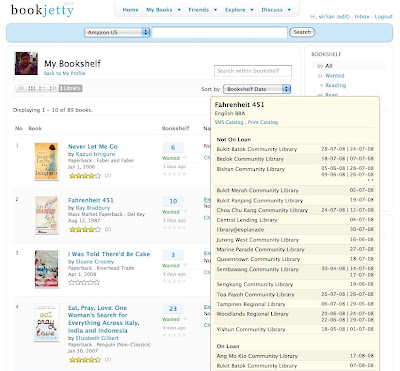
Another great feature is the SMS notification service. I can SMS a library book’s call number and its branch locations to my iphone (two things are needed: a Twitter account and a one-time activation from BookJetty). No more copying the details on slips that may get lost. Or if the book is not available from my neigbourhood branch, Sembawang Community Library (SCL), I can head over to NLB’s Public Library website to reserve the book from other branches and collect it at SCL, for a token fee.
Intuitive
Looks and ease-of-use matter. The design of BookJetty has an uncluttered, minimalist feel to it. Its book-tagging feature is intuitive to use, like how tags are assigned to links on Delicious, my favourite social bookmarking site.
In addition to multiple tags per book, you can organise the books on your virtual bookshelf by status categories (Wanted, Reading, Read, Dropped) and personal comments (favorites, ratings, reviews).
Inspiring
Naming things appropriately is an art. I’m not sure how BookJetty got its name but in my mind, “jetty” conjures a calming, soothing image of a humble man-made structure extending from shore into a wide expanse of lake-water.
Better and Better
Three months ago, BookJetty rolled out a new user interface with additional Facebook-like elements. Users can now follow fellow users’ bookshelves, initiate/take part in book discussions, converse via wall posts, etc. Last month, more enhancements were introduced, eg. users can become fans of authors.
So I’m sticking with BookJetty. You can join too, if you are not already part of the community.
For me, I tried the more popular LibraryThing but moved to BookJetty because of its integration with local libraries, intuitive interface, and inspiring name.
Integrated
Designed and developed by Herryanto Siatono, BookJetty has integrated with more than 300 libraries worldwide, including Singapore’s National Library Board (NLB).
So why do I find this so cool? Because I can conveniently track down interesting books to borrow and read first, without or before buying them. From your BookJetty bookshelf, you can check any book’s availability, its call number, and which library branches carry the book (see screen shot below), using the “List with library search” view (you just need to add your preferred library in the account settings).
Another great feature is the SMS notification service. I can SMS a library book’s call number and its branch locations to my iphone (two things are needed: a Twitter account and a one-time activation from BookJetty). No more copying the details on slips that may get lost. Or if the book is not available from my neigbourhood branch, Sembawang Community Library (SCL), I can head over to NLB’s Public Library website to reserve the book from other branches and collect it at SCL, for a token fee.
Intuitive
Looks and ease-of-use matter. The design of BookJetty has an uncluttered, minimalist feel to it. Its book-tagging feature is intuitive to use, like how tags are assigned to links on Delicious, my favourite social bookmarking site.
In addition to multiple tags per book, you can organise the books on your virtual bookshelf by status categories (Wanted, Reading, Read, Dropped) and personal comments (favorites, ratings, reviews).
Inspiring
Naming things appropriately is an art. I’m not sure how BookJetty got its name but in my mind, “jetty” conjures a calming, soothing image of a humble man-made structure extending from shore into a wide expanse of lake-water.

Better and Better
Three months ago, BookJetty rolled out a new user interface with additional Facebook-like elements. Users can now follow fellow users’ bookshelves, initiate/take part in book discussions, converse via wall posts, etc. Last month, more enhancements were introduced, eg. users can become fans of authors.
So I’m sticking with BookJetty. You can join too, if you are not already part of the community.
Music of Creation
Watch this 3-minute video: a Google engineer, Bruno Bowden, performed origami magic, blindfolded, to the music played by cellist, Rufus Cappadocia, on his custom 5-string electric cello. Be amazed by the paper-figure created.
The Songlines
The Songlines
By Bruce Chatwin
New York: Penguin Books, 1988
A fictional journey across Australia to the core of Aboriginal culture turned into a quest to understand the nature of human restlessness.
Nomadic cultures, in this case, the Australian Aboriginals, were often thought to be barbaric and inferior in their way of life. On the contrary, the author suggested they had much to teach us, especially their intimate knowledge of and sacred respect for the land they live in.
Wendy said that, even today, when an Aboriginal mother notices the first stirrings of speech in her child, she lets it handle the ‘things’ of that particular country: leaves, fruits, insects and so forth.More intriguing were the Aboriginal creation myths. To the Aboriginals, their Ancestors had sung the world into existence during the Dreamtime, when they travelled across the country, marking their primeval journeys with musical notes. These Songlines or Dreaming-tracks, also known as Footprints of the Ancestors, were inherited by the generations through sacred rituals.
The child, at its mother’s breast, will toy with the ‘thing’, talk to it, test its teeth on it, learn its name, repeat its name – and finally chuck it aside.
‘We give our children guns and computer games,’ Wendy said. ‘They gave their children the land.’ (p. 270)
In theory, at least, the whole of Australia could be read as a musical score. There was hardly a rock or creek in the country that could not or had not been sung. One should perhaps visualize the Songlines as a spaghetti of Iliads and Odysseys, writhing this way and that, in which every ‘episode’ was readable in terms of geology. (p. 13)In the second half of the book, the author pondered on the roots of human wanderlust. In a leap of faith, he declared that the desire to travel had its origins in our evolutionary past.
I have a vision of the Songlines stretching across the continents and ages; that wherever men have trodden they have left a trail of song (of which we may, now and then, catch an echo); and that these trails must reach back, in time and space, to an isolated pocket in the African savannah, where the First Man opening his mouth in defiance of the terrors that surrounded him, shouted in the opening stanza of the World Song, ‘I AM!’ (p. 282)
Intoxicated with Search
Image credit: richdrogpa
I read The Remains of the Day and wrote the previous post before Google was the rage.
Today, you can search for information (eg. reviews, explanations, discussions) about any book from a dozen websites. And you can speed up your search with browser-embedded search tools and tab-browsing options. By typing the book title in quotes once, I can search Amazon, Google, Wikipedia, Answers.com, SparkNotes, WikiSummaries, etc. from Firefox without visiting those websites, and navigate the results in tabs within the same window.
Sometimes I get intoxicated with the power of search. The results are:
a) Information overload.
b) I need not read the actual text anymore, which is time-consuming. Reading the detailed summaries and notes about the original book is faster.
c) I don’t have to make sense of the stuffs I read anymore, as contemplation is too slow. The interpretations are all out there, on the internet, accessible from a few clicks. Maybe Google is making us stupid.
But the dark side has its uses. I am forced to make choices: to ruthlessly discard irrelevant information. With the help of concise previews, I can better decide on what to or not to read.
The insights from other people have deepened my own understanding. To end off with two examples, on regrets:
1. The book title, “The Remains of the Day”, has multiple meanings. The phrase refers to evening and old age, both periods conducive for reflection. The word, “Remains”, suggests that the narrator’s life had been a wreck, filled with regrets.
2. In Harry Potter and the Deathly Hallows, the scene, when the dying Snape pleaded Harry Potter to look into his eyes, had an emotional significance that was not apparent. Snape craved to “see” his one true love, Lily Evans, for the last time (Harry Potter had his mother’s eyes). Perhaps Snape wanted to “tell” Lily (or really himself) that all the sacrifices he made for her were worthwhile, even if unrequited, and he would die with no regrets. This changed my whole perspective on Snape and ignited a brief desire to re-read the series.
The Remains of the Day

|
The Remains of the Day
By Kazuo Ishiguro London: Faber and Faber, 1999 (Winner of the 1989 Booker Prize) |
In 1956, an English butler took a week off to visit an old friend. During the motorcar trip, he recounted the golden years of his career as a butler, which spanned two world wars, and his relationships with various persons, mainly his father, ex-employer and the old friend.
The butler’s dedication to his profession might be considered excessive. His ideal of dignity was the ability to deliver first-class service in the midst of chaos, even when the turmoil was in one’s heart. Dignity he upheld, but at the expense of his private life.
As with most tales that recollected glorious memories, a sense of inevitable loss permeated the butler’s story. The realisation that things could never be the same again was a sad moment. Perhaps of greater sorrow was the loss of a mutual love that could have blossomed under different circumstances.
Nevertheless, the book ended on an optimistic note. Hope, the butler learnt, lies in looking forward, not backward (travel, after all, is a journey of self-discovery). Honest, self-critical, and at times humourous, The Remains of the Day was a delight to read.
Books Everywhere
Image credit: ntr23
Books in the air,The inspiration for this short verse came from two books. First, in A Passion for Books, I chanced upon this charming poem (p. 139):
Books everywhere,
Like Dorothy’s Silver Shoes,
They can take you anywhere.
My Pop is always buying books:To someone who frequently buys books, the unpleasant prospect of books stacking everywhere in my house is a certainty (just a matter of time).
So that Mom says his study looks
Just like an old bookstore. The bookshelves are so full and tall,
They hide the paper on the wall,
And there are books just everywhere,
On table, window-seat, and chair,
And books right on the floor.
And every little while he buys
More books, and brings them home and tries
To find a place where they will fit,
And has an awful time of it.
Once, when I asked him why he got
So many books, he said, “Why not?”
I’ve puzzled over that a lot.
(From Jane, Joseph, and John, by Ralph Bergengren.)
Thanks to advances in scanning and search technology, such a scenario can be avoided. Books have taken alternative forms such as audio files and pdf documents. They can be accessed over the air (think Wi-Fi).
Second, from googling the phrase “books in the air”, I found a 2002 diary post that made reference to a magical artifact in The Wonderful Wizard of Oz. It was the pair of silver shoes that the Witch of the North took from the deceased, wicked Witch of the East and gave to Dorothy. At the end of her adventures, Glinda the Good Witch of the South revealed how the Silver Shoes could carry her to any place in the world, including back home.
So it is with books.
About this Blog
Here are the reasons why I started (and therefore what you can expect from) this blog:
The inspiration for the title is mentioned in this next post, Books Everywhere.
About Me
My name is Lian Tiong Thye. A married guy, I turn 34 this year and live in Singapore. You can email me at ttlian (at) gmail (dot) com.
- To keep a reading diary of sorts, with quotes from books (or other media), and thoughts plus reviews.
- To share my reading experience - the joy of browsing, borrowing, and buying books, the pleasure that reflection, reading secondary texts, or re-reading, can bring.
- To join the ongoing conversations in the blogosphere about the future of books and reading.
The inspiration for the title is mentioned in this next post, Books Everywhere.
About Me
My name is Lian Tiong Thye. A married guy, I turn 34 this year and live in Singapore. You can email me at ttlian (at) gmail (dot) com.
Subscribe to:
Posts (Atom)
