August 23, 2008
The late Carnegie Mellon Professor, Randy Pausch (1960-2008), gave the talk, Really Achieving Your Childhood Dreams, aka Last Lecture, on 18 September 2007, about a year after he was diagnosed with pancreatic cancer.
One of the life lessons he shared was indirect learning (what he called “head fake”) as a powerful teaching tool (eg. using storytelling to teach programming). The talk has two head fakes: 1) it is not about achieving dreams but how to lead your life, 2) it is not for the audience/viewers, but for his 3 kids. In April 2008, the book version of The Last Lecture was published.
On 25 July 2008, Randy Pausch passed away, leaving behind an enduring legacy.
If you want to watch the 75-minute talk (highly recommended), you may wish to block some quiet time for the experience.
Ideas I hope to imbibe from the lecture:
1. Be good at something by working hard.
2. Most of what we learn, we learn indirectly (“head fake”).
3. Experience is what you get when you didn’t get what you wanted.
4. Find the best in everybody; no matter how long you have to wait for them to show it.
5. Brick walls are there for a reason: they let us prove how badly we want things. Brick walls let us show our dedication.
August 16, 2008
August 15, 2008
August 10, 2008
August 6, 2008
August 3, 2008

The Songlines
By Bruce Chatwin
New York: Penguin Books, 1988
A fictional journey across Australia to the core of Aboriginal culture turned into a quest to understand the nature of human restlessness.
Nomadic cultures, in this case, the Australian Aboriginals, were often thought to be barbaric and inferior in their way of life. On the contrary, the author suggested they had much to teach us, especially their intimate knowledge of and sacred respect for the land they live in.
The Last Lecture
The late Carnegie Mellon Professor, Randy Pausch (1960-2008), gave the talk, Really Achieving Your Childhood Dreams, aka Last Lecture, on 18 September 2007, about a year after he was diagnosed with pancreatic cancer.
One of the life lessons he shared was indirect learning (what he called “head fake”) as a powerful teaching tool (eg. using storytelling to teach programming). The talk has two head fakes: 1) it is not about achieving dreams but how to lead your life, 2) it is not for the audience/viewers, but for his 3 kids. In April 2008, the book version of The Last Lecture was published.
On 25 July 2008, Randy Pausch passed away, leaving behind an enduring legacy.
If you want to watch the 75-minute talk (highly recommended), you may wish to block some quiet time for the experience.
Ideas I hope to imbibe from the lecture:
1. Be good at something by working hard.
2. Most of what we learn, we learn indirectly (“head fake”).
3. Experience is what you get when you didn’t get what you wanted.
4. Find the best in everybody; no matter how long you have to wait for them to show it.
5. Brick walls are there for a reason: they let us prove how badly we want things. Brick walls let us show our dedication.

Bedok Jetty
Last Saturday, Singapore celebrated her 43rd birthday. The weekend papers carried readers’ reflections and writers’ hopes for this country we call home. One article and one poem touched my heart. I summarised the article in the previous post.
The poem reproduced below, written by Jinat Rehana Begum, won the second prize among the readers’ contributions in Where We Call Home, The Straits Times National Day Supplement.
The poem reproduced below, written by Jinat Rehana Begum, won the second prize among the readers’ contributions in Where We Call Home, The Straits Times National Day Supplement.
 Image credit:
 Bedok Jetty
At five, I crossed the sea on a dare,
they pestered and pushed, till finally
the youngest of the tribe,
I wobbled on to the long grey finger,
sea to the left of me, sea to the right of me, sea beneath me
crashing, gnashing,
against pillars under the concrete plank,
hungry for young flesh.
Turning green, swaying sick, I turned back.
Don’t look down, Bodoh! Look straight!
Cheered by brotherly support,
I edged forward,
taking comfort in tall lampposts and the long
solid metal railings that followed me,
right to the edge of the world,
right to journey’s end, till finally
I stuck a hand victoriously
between the bars of the last metal railing.
Five fat fingers feeling
sea spray and mist.
Holding in my fist
a strange new smell
Of salt and fish.
At ten, I whizzed past old men
meditating on fish and courting couples,
rushing on wheels,
right to journey’s end
right to the last bars,
to spot new ships hiding the horizon,
cargo, tanker, carrier, cruise,
all waiting under sea and sky
spread so low, so close,
I’d stick out my tongue
to taste the clouds.
Wet, salty,
stinging the eyes,
sweat streaming down my face.
At fifteen, I gave up cycling and ran
up Lucky Heights, round Sennett estate,
under pedestrian tunnels, across the ECP,
through tangled bird sanctuaries,
dancing round cyclists, skaters and babies in prams,
dodging discarded silver tambans and knotted fishing lines,
right to the edge of the world
right to journey’s end
right to the final bars,
to breathe in great gulps
the old smell
Of salt and fish,
To watch planes fly in and out of Changi,
To laugh
as snapper, grouper, stingray, eel
Played peek-a-boo with fresh young anglers.
At eighteen, I came with noisy friends,
to crouch on prime spots of concrete
beside benches packed with early-bird kiasus
to watch the sun slide behind tall buildings,
to giggle above the babble
at fireworks on National Day,
at trails of pink, red, white, blue, yellow, green,
lighting the ships silhouetted in the dark,
at the smoky odour of sweaty bodies, gunpowder
and barbeque chicken. And still,
to breathe the old smell
of salt and fish.
At twenty, I came
when even the ships were dark with sleep,
when only the organge glow from lampposts
and the bright white moonlight lit the night.
When only an old man cik tuning her portable radio
and her old man fighting with the knots of their filmsy tarp
Disturbed the quiet.
Crossing the sea on moonlit white concrete,
I walked right to the edge of the world
Right to journey’s end
to breathe the old friendly smell of salt and fish
To say goodbye
against static croons of Sayang Sayang.
And then I searched everywhere,
Crossing different seas on different piers,
for ships that hide horizons,
For silver fish skimming the waves,
for cheering friends,
for the scent of first victories,
that old smell of salt and fish,
The smell of home.
A Bit of Earth
Last Saturday, Singapore celebrated her 43rd birthday. The weekend papers carried readers’ reflections and writers’ hopes for this country we call home. One article and one poem touched my heart. I summarised the article in this post. The poem can be found in the next post.
I found hope in the prose of Christine Suchen Lim. In the article, she pondered on why she loves Singapore. She asked if readers would still love a Singapore stripped of her wealth, shopping malls, standard of living, leaders, hawker food, etc. The writer would because of quiet places, a crooked path and two cleaners.
Born in Malaysia, she migrated to Singapore at age 14 in the 1960s. Her daily morning walks, along the East Coast beach under the angsana trees, to a school by the sea helped her to cope with a new life in a foreign land. The beach and the sea became her sanctuary, quiet places she started to love. She found solace in the ancient “songs and voices embedded in this bit of earth.”
The writer reminded readers of the possibilities that dwell within us, the individual paths that we can create. She offered the imagery of a crooked “path of beaten earth, made by anonymous feet that quietly went off tangent; feet that refused to follow the straight-as-the-crow-flies concrete path built by the authorities.” This is in contrast to “nature in neat grids, rows of trees and bushes planted at regular intervals.”
The writer takes pride in our literary heritage, Singapore’s creative blend of “Singlish, pasar Malay or pasar Mandarin.” She celebrated an ordinary conversation between an Indian cleaner and a Chinese cleaner, how they chatted in a mix of local dialects, while sharing bread, feeding birds.
There is hope. It is possible to find meaning in simple things - enjoying nature, exploring new trails, chatting with friends - when our hearts are willing.
The quotes are from the article, A Bit of Earth in the Sun, by Christine Suchen Lim, published in The Straits Times, on Sunday, 10 August 2008. The full text can be found on wildsingapore news blog.
I found hope in the prose of Christine Suchen Lim. In the article, she pondered on why she loves Singapore. She asked if readers would still love a Singapore stripped of her wealth, shopping malls, standard of living, leaders, hawker food, etc. The writer would because of quiet places, a crooked path and two cleaners.
Born in Malaysia, she migrated to Singapore at age 14 in the 1960s. Her daily morning walks, along the East Coast beach under the angsana trees, to a school by the sea helped her to cope with a new life in a foreign land. The beach and the sea became her sanctuary, quiet places she started to love. She found solace in the ancient “songs and voices embedded in this bit of earth.”
The writer reminded readers of the possibilities that dwell within us, the individual paths that we can create. She offered the imagery of a crooked “path of beaten earth, made by anonymous feet that quietly went off tangent; feet that refused to follow the straight-as-the-crow-flies concrete path built by the authorities.” This is in contrast to “nature in neat grids, rows of trees and bushes planted at regular intervals.”
The writer takes pride in our literary heritage, Singapore’s creative blend of “Singlish, pasar Malay or pasar Mandarin.” She celebrated an ordinary conversation between an Indian cleaner and a Chinese cleaner, how they chatted in a mix of local dialects, while sharing bread, feeding birds.
There is hope. It is possible to find meaning in simple things - enjoying nature, exploring new trails, chatting with friends - when our hearts are willing.
The quotes are from the article, A Bit of Earth in the Sun, by Christine Suchen Lim, published in The Straits Times, on Sunday, 10 August 2008. The full text can be found on wildsingapore news blog.
A Jetty for Your Books
Video, photo, slideshow enthusiasts use popular social media sites, such as Flickr, YouTube, SlideShare to manage, share, discover interesting works, including their own. The equivalent communities for avid readers are LibraryThing and Shelfari (see The Big List of Bookish Social Networks.
For me, I tried the more popular LibraryThing but moved to BookJetty because of its integration with local libraries, intuitive interface, and inspiring name.
Integrated
Designed and developed by Herryanto Siatono, BookJetty has integrated with more than 300 libraries worldwide, including Singapore’s National Library Board (NLB).
So why do I find this so cool? Because I can conveniently track down interesting books to borrow and read first, without or before buying them. From your BookJetty bookshelf, you can check any book’s availability, its call number, and which library branches carry the book (see screen shot below), using the “List with library search” view (you just need to add your preferred library in the account settings).
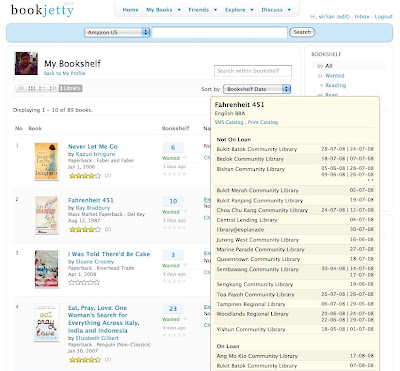
Another great feature is the SMS notification service. I can SMS a library book’s call number and its branch locations to my iphone (two things are needed: a Twitter account and a one-time activation from BookJetty). No more copying the details on slips that may get lost. Or if the book is not available from my neigbourhood branch, Sembawang Community Library (SCL), I can head over to NLB’s Public Library website to reserve the book from other branches and collect it at SCL, for a token fee.
Intuitive
Looks and ease-of-use matter. The design of BookJetty has an uncluttered, minimalist feel to it. Its book-tagging feature is intuitive to use, like how tags are assigned to links on Delicious, my favourite social bookmarking site.
In addition to multiple tags per book, you can organise the books on your virtual bookshelf by status categories (Wanted, Reading, Read, Dropped) and personal comments (favorites, ratings, reviews).
Inspiring
Naming things appropriately is an art. I’m not sure how BookJetty got its name but in my mind, “jetty” conjures a calming, soothing image of a humble man-made structure extending from shore into a wide expanse of lake-water.
Better and Better
Three months ago, BookJetty rolled out a new user interface with additional Facebook-like elements. Users can now follow fellow users’ bookshelves, initiate/take part in book discussions, converse via wall posts, etc. Last month, more enhancements were introduced, eg. users can become fans of authors.
So I’m sticking with BookJetty. You can join too, if you are not already part of the community.
For me, I tried the more popular LibraryThing but moved to BookJetty because of its integration with local libraries, intuitive interface, and inspiring name.
Integrated
Designed and developed by Herryanto Siatono, BookJetty has integrated with more than 300 libraries worldwide, including Singapore’s National Library Board (NLB).
So why do I find this so cool? Because I can conveniently track down interesting books to borrow and read first, without or before buying them. From your BookJetty bookshelf, you can check any book’s availability, its call number, and which library branches carry the book (see screen shot below), using the “List with library search” view (you just need to add your preferred library in the account settings).
Another great feature is the SMS notification service. I can SMS a library book’s call number and its branch locations to my iphone (two things are needed: a Twitter account and a one-time activation from BookJetty). No more copying the details on slips that may get lost. Or if the book is not available from my neigbourhood branch, Sembawang Community Library (SCL), I can head over to NLB’s Public Library website to reserve the book from other branches and collect it at SCL, for a token fee.
Intuitive
Looks and ease-of-use matter. The design of BookJetty has an uncluttered, minimalist feel to it. Its book-tagging feature is intuitive to use, like how tags are assigned to links on Delicious, my favourite social bookmarking site.
In addition to multiple tags per book, you can organise the books on your virtual bookshelf by status categories (Wanted, Reading, Read, Dropped) and personal comments (favorites, ratings, reviews).
Inspiring
Naming things appropriately is an art. I’m not sure how BookJetty got its name but in my mind, “jetty” conjures a calming, soothing image of a humble man-made structure extending from shore into a wide expanse of lake-water.

Better and Better
Three months ago, BookJetty rolled out a new user interface with additional Facebook-like elements. Users can now follow fellow users’ bookshelves, initiate/take part in book discussions, converse via wall posts, etc. Last month, more enhancements were introduced, eg. users can become fans of authors.
So I’m sticking with BookJetty. You can join too, if you are not already part of the community.
Music of Creation
Watch this 3-minute video: a Google engineer, Bruno Bowden, performed origami magic, blindfolded, to the music played by cellist, Rufus Cappadocia, on his custom 5-string electric cello. Be amazed by the paper-figure created.
The Songlines
The Songlines
By Bruce Chatwin
New York: Penguin Books, 1988
A fictional journey across Australia to the core of Aboriginal culture turned into a quest to understand the nature of human restlessness.
Nomadic cultures, in this case, the Australian Aboriginals, were often thought to be barbaric and inferior in their way of life. On the contrary, the author suggested they had much to teach us, especially their intimate knowledge of and sacred respect for the land they live in.
Wendy said that, even today, when an Aboriginal mother notices the first stirrings of speech in her child, she lets it handle the ‘things’ of that particular country: leaves, fruits, insects and so forth.More intriguing were the Aboriginal creation myths. To the Aboriginals, their Ancestors had sung the world into existence during the Dreamtime, when they travelled across the country, marking their primeval journeys with musical notes. These Songlines or Dreaming-tracks, also known as Footprints of the Ancestors, were inherited by the generations through sacred rituals.
The child, at its mother’s breast, will toy with the ‘thing’, talk to it, test its teeth on it, learn its name, repeat its name – and finally chuck it aside.
‘We give our children guns and computer games,’ Wendy said. ‘They gave their children the land.’ (p. 270)
In theory, at least, the whole of Australia could be read as a musical score. There was hardly a rock or creek in the country that could not or had not been sung. One should perhaps visualize the Songlines as a spaghetti of Iliads and Odysseys, writhing this way and that, in which every ‘episode’ was readable in terms of geology. (p. 13)In the second half of the book, the author pondered on the roots of human wanderlust. In a leap of faith, he declared that the desire to travel had its origins in our evolutionary past.
I have a vision of the Songlines stretching across the continents and ages; that wherever men have trodden they have left a trail of song (of which we may, now and then, catch an echo); and that these trails must reach back, in time and space, to an isolated pocket in the African savannah, where the First Man opening his mouth in defiance of the terrors that surrounded him, shouted in the opening stanza of the World Song, ‘I AM!’ (p. 282)
Subscribe to:
Posts (Atom)
